For the thousands of farmers, such as the Haji Gora Damambe from Chad in the arid and semi-arid areas of West Africa and beyond, recent benefits of agriculture technology offer more than economic gains—they are the key to food security, resilience to shocks and stresses, and even reversing the downward growth and development the developing world is trapped in.
This is important on the day that we mark the World Environment Day to remind every policy- and decision-maker, from the grassroots to the global platforms, that agriculture is not the villain in environmental degradation. Rather, it holds the key to global efforts for environmental regeneration and sustainable development.
It is estimated that we will require 60% more food by 2050 to nourish the world’s population, while agriculture’s own productivity is threatened by climate change and degradation of the very resources it depends on, from water to soils to biodiversity and genetic resources.
Despite the existential challenge, farmers across the drylands are defying challenges that would defeat even the most intrepid entrepreneurs. They produce not just particularly diverse, nutritious and resilient crops like sorghum, millets, pigeonpea, and groundnut, but also constitute the key to protecting the environment while ensuring food and nutrition security, improving livelihoods, and strengthening resilience.
These benefits can be seen in Africa through science, technology, and innovation-enabled agriculture for development. The work of the Agricultural Technology Foundation (AATF), and of my organization, the International Crops Research Institute for the Semi-Arid Tropics (ICRISAT), has supported millions of farmers in Africa through science-based innovations for smallholder farmers in the drylands.
At the heart of agricultural innovation and technology solutions designed to increase productivity and enhance the resilience of agricultural systems, are crop and seed systems that can thrive in harsh, dryland ecosystems and help protect biodiversity.
We are already achieving this at scale in many countries, including the area under climate-smart crops such as millets, sorghum, and groundnuts. In addition to delivering crop varieties that can better withstand the shocks of climate change, we also provide farmers with a range of crop and land management practices designed to increase productivity and reduce environmental degradation.
Some of the key issues being developed include the ability to understand what traits make crops and plants more resilient to harsh conditions, and/or more efficient in their use of limited, and dwindling resources such as water, fertilizer, and energy.
Thanks to our decades of innovation, breeding, and partnership, we now have over 130 improved crop varieties—ranging from short-duration, high-yielding pigeonpea to groundnut and pearl millet—commercialized across Sub-Saharan Africa.
In countries like Nigeria, Kenya, Uganda, and Ghana, these proven technologies are deployed in several development programs to help smallholder farmers adopt smart solutions to help build resilience in a climate-challenged future.
The African Agricultural Technology Foundation (AATF) and its partners have facilitated access to climate-smart technologies such as StrigAway, a herbicide-resistant maize developed under the Striga Control in Maize Production (STRICOM) project with IITA, CIMMYT, and BASF. AATF has also delivered the Nitrogen-use Efficient Water-use Efficient and Salt-tolerant (NEWEST) rice varieties and the drought-tolerant Water Efficient Maize for Africa (WEMA) varieties in Africa.
In recent efforts across Ethiopia, Tanzania, AATF is working with partner providers to deliver climate-resilient crop varieties, including high-yielding hybrid rice, drought-tolerant and disease-resistant banana and cassava varieties to help farmers cope with climate-induced challenges.
There is also growing adoption of mechanization and precision agriculture tools such as tractors and planters to increase productivity and reduce post-harvest losses.
It is important for us to really break away from one-size-fits-all. Some Northern Hemisphere solutions may not work. Indigenous solutions must be central to this process. It means shifting the development discourse to not just empowering communities to identify and deploy solutions, but ensuring that these solutions work for them.
In the wake of climate extremes, AATF and ICRISAT have joined other actors to offer farmer-centric and place-specific approaches. Our collaboration with key regional actors such as the African Union and African governments are key to scaling the innovation and delivering real impact.
This response must also include farmer voices because together these ideas are changing livelihoods, businesses, and communities. ICRISAT’s Climate-Smart Village approach being implemented in partnership with key players including FAO and IFAD has supported integrated rural development through sustainable agricultural practices, income generation, and collective community-led development.
Promoting climate-smart actions must come from the youth, while developing new partnerships between the private sector, government and civil society to ensure the research agenda is owned by those who need it most—our farmers.
The critical role of women farmers, who play their part as sources of resilience, producing nutrition and income, cannot be overstated. The Women in Agriculture (WIA) initiative, supported by AATF, continues to support access to new knowledge and networks for women farmers.
In our work across the drylands, we’ve seen how the power of research can support regenerative agriculture that helps combat desertification, and improves food and nutrition security and livelihoods.
Science-based, locally-developed solutions have helped Mali, by example, to roll out improved millet and groundnut varieties that are better suited to survive, and even flourish, in an increasingly volatile climate.
Let’s continue to use today’s moment to move us closer.
—Dr. Jacqueline Hughes
Digital tools are perhaps the fastest developing NextGen solutions that help to connect institutions and actors across agricultural value chains for transformation in the field.
Digital technology applications in developing regions are extensively deployed to increase access to extension services. In climate-smart agriculture information-intensive small production areas, farmers in Niger (10) can monitor connectivity via GPS-guided sensors, depending on their user need (based on GPS data and microclimate, weather and moisture zones).
AATF leads on mechanisation initiatives to increase productivity through improved machinery for farmer operations; has facilitated the development of digital App technologies in Nigeria to enable mechanised delivery by service providers; and coordinates harmonised mechanisation at the time of value chain productivity in more than seven countries in the region.
AATF is supporting the roll-out of more data-friendly generation solutions that align AI analytics, data visualisation, and machine-driven intelligence to increase farmer decision-making, land and environmental use, and crop finance.
Digital integration has helped cut value chain break points across the data chain. AI analysis helps in early detection of disease, boosting predictability of farming production. At scale, the ecosystem of these NextGen solutions supports efforts to improve the resilience of smallholder food systems, reducing barriers to input/output markets, and boosting market growth.
Scaling NextGen applications will require action. AATF requires deliberate investment, policy coherence, digital infrastructure and farmer empowerment.
Governments, research institutions, and development partners must work together to ensure digital tools are better connected, better tested, and better coordinated. It is essential to accelerate the development, scale-up and deployment of NextGen tools in African agriculture, towards greater resilience.
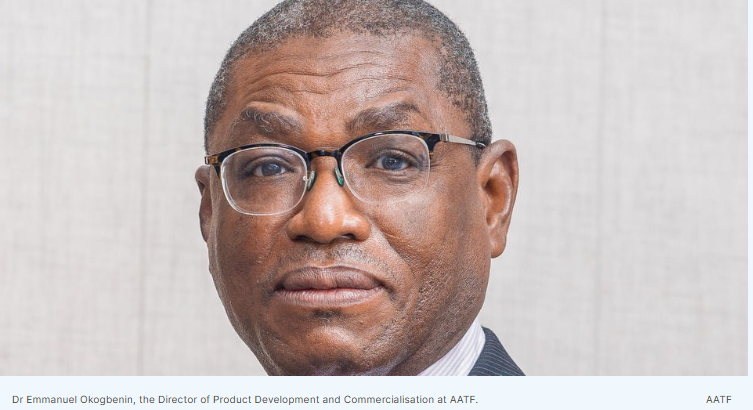
—Dr. Emmanuel Okogbenin
The author is the Director of Product Development and Commercialisation at AATF