PHONE NUMBER :
+27 81 781 3798
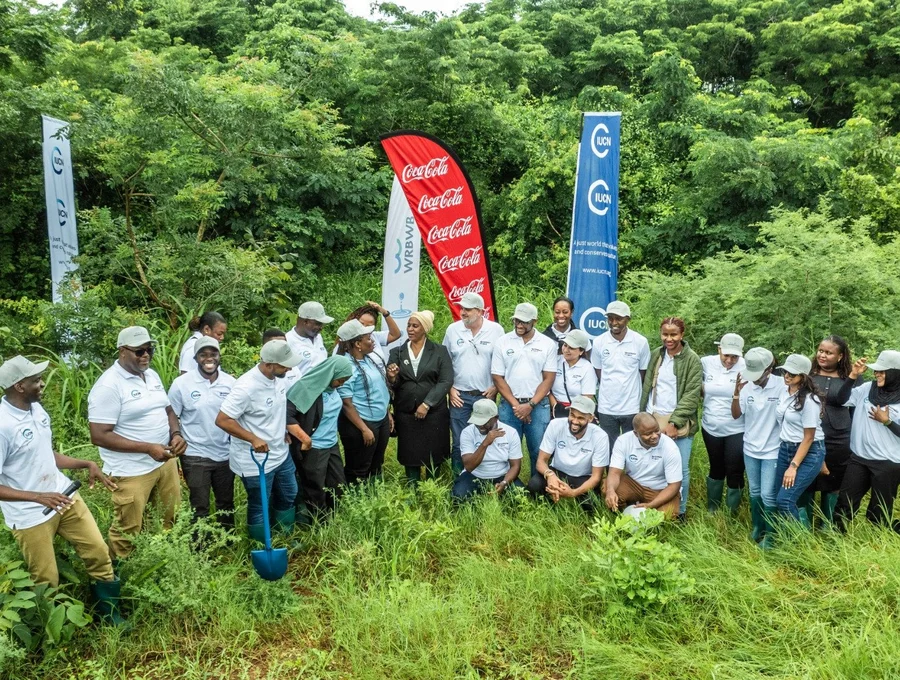
The Coca-Cola system in Tanzania is working on restoring the Ruvu Basin which serves the country’s commercial capital Dar es Salaam.
This project includes an investment of US$1.94m to provide a lifeline for communities, farms and businesses across eastern Tanzania.
This forms part of the Coca-Cola system’s Africa Water Stewardship Initiative, bringing water security to the continent.
Coca-Cola’s initiative focuses on improving water replenishment across Tanzania through nature-based solutions and restoring catchment areas.
It aims to support more sustainable water management in the Ngerengere catchment of the Ruvu sub-basin.
The company plans to strengthen its capacity for watershed management, help restore degraded catchment areas and promote water stewardship.
David Chait, Managing Director of Coca-Cola Kwanza, says: “As part of the Coca-Cola Beverages Africa Group, we have a responsibility to assist those who face water scarcity and to help protect local water resources where we operate, especially in places with the biggest challenges.
“The Coca-Cola system’s Africa Water Stewardship Initiative aims to help protect and enhance the health of important watersheds and to improve access to water and sanitation services in local communities.”

The project is led by the Global Water Challenge (GWC), which is a leader in mobilising clean water access, advancing water security and community empowerment in high need regions around the world.
It is implemented by the International Union for Conservation of Nature (IUCN), in partnership with the Wami-Ruvu Basin Water Board (WRBWB).
IUCN is one of the world’s largest environmental networks, working to help societies conserve nature and ensure that natural resources are used sustainably and equitably.
In Tanzania, IUCN aims to preserve and restore the natural environment through aligning its work with national development strategies and environmental priorities in the country.
The project aims to bring on-the-ground impact, through tree planting and the uptake of more climate resilient livelihood practices.
These practices are predicted to benefit at least 2,000 farmers in the region.
Charles Oluchina, Country Representative, IUCN Tanzania, says: “We are proud to be the implementing partner, alongside WRBWB, for this project.

“This initiative is aimed at helping to protect and restore the RUBU sub-basin focusing on Ngerengere catchment through nature-based solutions and improving water security and livelihoods for communities.”
This work is taking place as part of Coca-Cola’s Africa Water Stewardship Initiative, which was launched in 2024.
The initiative represents an almost US$25m investment to help address critical water-related challenges in local communities in 20 African countries by 2030.
It was launched to tackle issues of water insecurity in Africa, with demand outstripping supply in many regions in the continent.
Coca-Cola is working in partnership with organisations and governments to improve access to clean water and protect local water resources.
It aims to contribute to the United Nations’ Sustainable Development Goal 6, which involves ensuring availability and sustainable management of water and sanitation.
Alfred Olajide, Vice President, Franchise Operations, East and Central Africa at Coca-Cola, says: “The world is experiencing increased water insecurity, which is evident through water scarcity, with demands for safe, usable water exceeding supply in certain areas and scarcity challenges forecast to increase in the future.

“The Coca-Cola system intends to continue focusing on promoting water stewardship, increasing water use efficiency and treating and returning safe water to communities.
“Recognising that partnerships are critical to support this work, Coca-Cola and its authorised bottlers are collaborating with governments, businesses and civil society organisations to design and implement strategic interventions for a better shared future.”
As countries accelerate efforts toward more sustainable and low-carbon economies, increasing attention is being given not only to environmental outcomes, but to how the transition is structured—and who it benefits.
Across Africa, the concept of a just transition is gaining traction. It reflects a growing recognition that sustainability must be pursued in a way that protects livelihoods, supports economic participation, and avoids deepening existing inequalities.
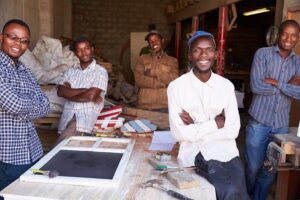
A key part of this discussion is the role of cooperative and collective business models. These models, which are widely used across sectors such as agriculture, finance, and small-scale manufacturing, enable shared ownership and collective decision-making. In doing so, they provide a pathway for individuals and communities—particularly those operating in informal or rural economies—to participate more meaningfully in economic systems.
This is particularly important in the context of sustainability. As environmental standards evolve and global markets place greater emphasis on responsible sourcing and climate resilience, smaller producers and businesses risk being excluded if they are unable to meet new requirements independently.
Cooperatives can help address this challenge by pooling resources, improving access to finance, and strengthening market access. They also create opportunities for shared investment in sustainable practices, enabling members to adapt to changing environmental and economic conditions more effectively.
Beyond their economic function, cooperative models also support social outcomes. By promoting inclusive participation and local ownership, they contribute to more equitable distribution of benefits and help build resilience at a community level.
However, ensuring that these models are effectively integrated into broader sustainability strategies remains a challenge. In many cases, financial systems, investment frameworks, and policy environments are not fully aligned to support inclusive approaches. This creates a disconnect between sustainability ambitions and the realities faced by smaller or less formal economic actors.
Addressing this gap will be critical to the success of sustainability efforts across the continent. Without deliberate inclusion, there is a risk that the transition to greener economies could reinforce existing disparities rather than reduce them.
As the sustainability agenda continues to evolve, there is growing consensus that environmental progress cannot be separated from economic and social considerations. A just transition—one that is inclusive, locally grounded, and economically viable—will be essential to ensuring that sustainability delivers long-term benefits across all levels of society.